By: Adrielle Farias
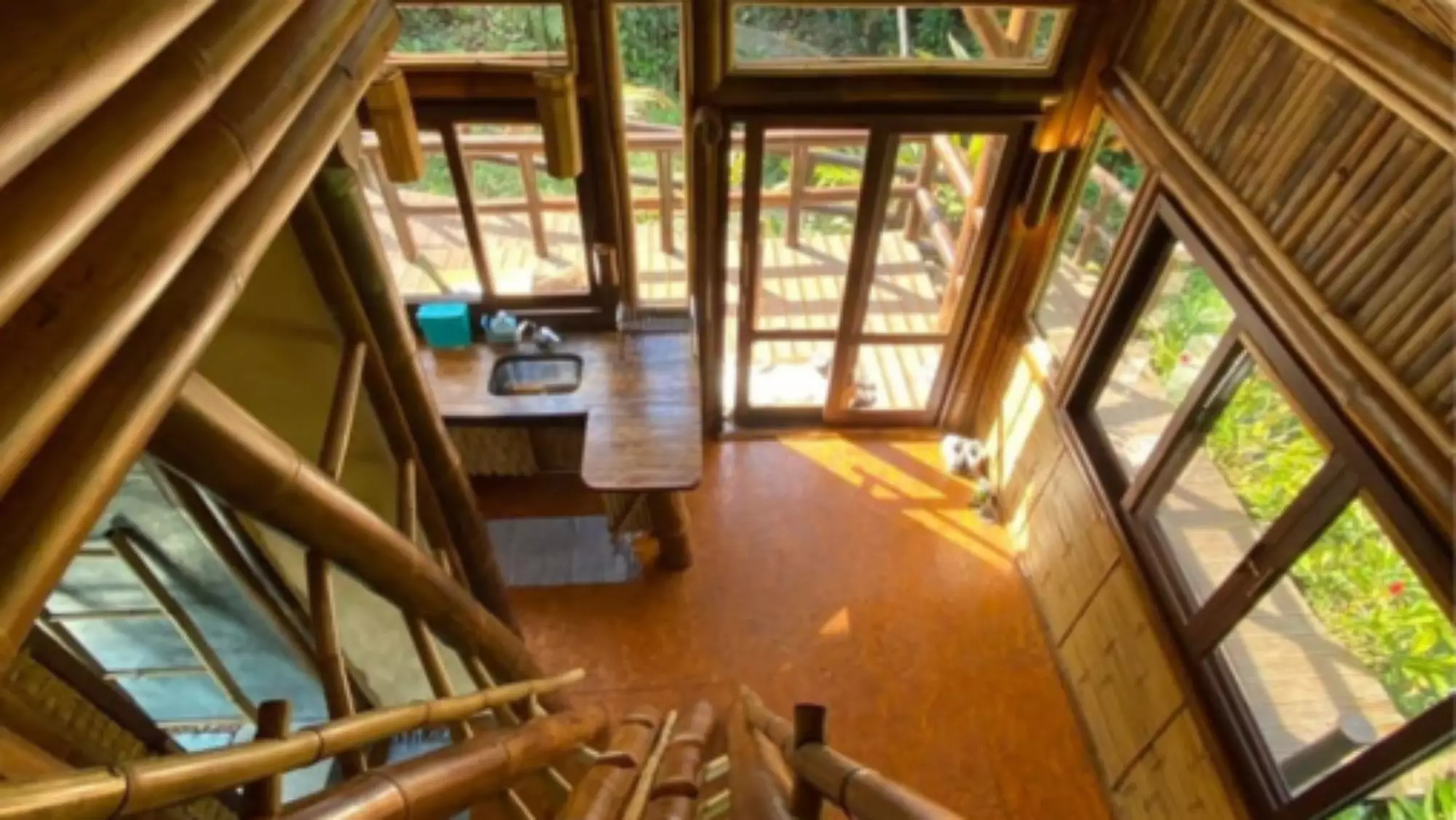
It may look like a movie scene, but it’s not: in the middle of the Atlantic Forest, in the municipality of Caçapava, in the countryside of São Paulo, a house made of bamboo was one of the dreams of 43-year-old Bruno Sales Mota that came true. With a degree in agronomic engineering, Mota became a bamboo farmer and decided to follow the career he had dreamed of since childhood, with a specific focus on bioconstruction.
“Since I was very young, I’ve always liked construction. I followed every building project on the farm where I lived. In college, I had the wonderful opportunity to work on a project at Embrapa and almost became a scientist. That’s how I gained my knowledge of bamboo—I explored that area a lot. It’s something that’s in my blood,” the farmer told Terra in an interview.
The integration of one’s home with nature is among the main reasons why people choose bioconstruction. The technique used in construction employs natural materials to build large structures and has gained popularity in recent years.
Among the main materials used in this sector is bamboo. Besides being the fastest-growing plant in the world, bamboo has a high carbon-capture capacity during photosynthesis. This makes homes built from it more sustainable and eco-friendly than those made from conventional construction materials.
In Mota’s case, the choice of bamboo was driven mainly by its structural potential, its ability to regrow easily, and the way it harmonizes with nature. “It’s a plant that requires very little energy to form. It’s like wooden steel. It also has the unique trait of not needing replanting because it sprouts again every year. So, you have a plant that’s always providing raw material without any effort,” he explains.
In addition to his residence in Caçapava, the farmer also invested in constructions in Ubatuba, on the São Paulo coast, and in Miguel Pereira, in Rio de Janeiro.
“I have several houses and structures in different parts of Brazil. If you have the right project, the chance of something going wrong is very low. You do need to maintain a bamboo house, just like any other conventional home. When you have a well-executed project and follow building codes, there are no issues,” he says.
Besides being a sustainable housing option, bamboo construction also provides a peaceful routine for residents. Because it’s hollow and contains fibers that retain air, bamboo has natural thermal insulation, helping the home avoid extreme heat or cold depending on the temperature.
“The issue of thermal insulation also depends on the project. If you want more insulation, then you have to plan for it, but bamboo already has its own natural insulation,” he explains. Typically, in warmer regions, bamboo makes the home more ventilated. In colder areas, using earth or clay can reinforce insulation and keep the interior from getting too cold.
The placement of windows in bamboo houses also depends on the owner’s preferences. “You can put windows wherever you want—office, bedroom—but if you add too many, you might compromise insulation, just like in a house with too much glass,” he adds.
Even though it’s a natural material, Mota says bamboo usually isn’t “attacked” by animals or insects, and proper maintenance can prevent future issues. “If bamboo is treated, there’s absolutely no problem. It doesn’t attract insects,” he says.
The main difference between a concrete house and a bamboo one lies in the material and structure. In everyday life, a bamboo house can even offer greater aesthetic, acoustic, and thermal comfort.
“With concrete, you can make square open spans and design square beams—like those seen in parking lots or buildings—because that shape optimizes space. With bamboo, you can’t do that, but you can create other, more daring structural designs with bold aesthetics, which make the house more visually appealing,” he points out.
A growing market
According to Mota, the bamboo market for construction is heating up and expanding year after year. “The material could become cheaper as more farmers grow, treat, and stock bamboo for sale. Besides, you can use it for everything in the house, including decoration,” he adds.
The same view is shared by Rafael Fiuza, specialist and co-founder of Erre Bambu. He also believes the market is thriving and that bamboo is a raw material that helps people reconnect with nature.
“Bamboo has a strong ability to bring humans closer to the natural environment. You can preserve its natural aesthetics in both furniture and buildings. Bamboo poles are usually kept intact. Its so-called ‘imperfections’ are what make it even more beautiful,” he notes.
Although it’s a sustainable technique that values environmental preservation, bioconstruction still faces some myths. Fiuza stresses that bamboo must be applied with a solid, well-designed project.
Bamboo can also be used for furniture
“If you respect the harvesting process and properly treat the bamboo afterward, it becomes a highly durable material, comparable to fine woods. Like any natural material, it requires maintenance,” he says.
According to Fiuza, there is enormous demand in the market for bamboo in decorative pieces, furniture, lamps, and even ceiling panels.
“There’s a huge market for that—many artisans work with this material. Costs can vary greatly depending on the project. If it’s very elaborate and structurally complex, it’ll be more expensive. But if it’s designed for low cost, it’s totally feasible too,” he says.
According to data from the United Nations Environment Programme (UNEP), the environmental impact of the construction sector has decreased significantly, but it remains one of the main drivers of the climate crisis, consuming 32% of global energy and producing 34% of global carbon emissions.
“Additional measures, such as circular construction practices, green leases, energy retrofitting of existing buildings, and prioritizing the use of low-carbon materials, can further reduce energy consumption, improve waste management, and cut emissions overall,” the report states.
Source: Futuro Vivo
By: Adrielle Farias
https://www.terra.com.br/planeta/futuro-vivo/construcoes-sustentaveis-como-e-morar-numa-casa-de-bambu,c214cb43ecc769af0c1778ecaf1187817vss0g1o.html
Fonte: https://www.terra.com.br/


